
Posted 2/26/26
Welcome to The People Behind the Power™, where we showcase the extraordinary work Tri-State employees are doing to keep the lights on for our members across the rural West. This series pulls back the curtain to share the real stories of the individuals whose dedication powers our communities. Because when you meet the people behind the power, you see the heart, talent, and perseverance that goes into every flip of a switch.
Can you tell us a bit about yourself and your role?
My name is Nicole Viz and I’m a Demand Response Analyst. The main thing that I do is engage and assist our members with enrollment and participation in our four demand response programs. I’ve been with Tri-State for close to a year and a half, although this is a newer role for me. I started with the company after being awarded a fellowship through the Department of Energy (DOE) to study large-scale battery storage as part of our Energy Services team.
Battery storage is still a huge part of my role here, and I also assist with modeling, analyzing, and communicating the value of demand response. We’re currently in the process of modifying our existing program structures as well as developing new ones to better serve our members and bring value to Tri-State.
What drew you to engineering and how did you end up working in the utility space?
Math and science have always been my favorite subjects, but I struggled with studying electrical engineering in college. It wasn’t until I started taking power and energy courses and learning about the grid that I felt like I had found my field. I really appreciated the way all the technical engineering aspects are interconnected with things like history, economics, and politics.
Work-wise, after interning with a research team at the National Lab of the Rockies (formerly National Renewable Energy Lab), I was eager to get some hands-on experience in the energy landscape. My mentor suggested I apply for a fellowship position through the DOE. I then applied for this current demand response position, and the rest is history.
What skills—technical or otherwise—are most important for engineers in this field?
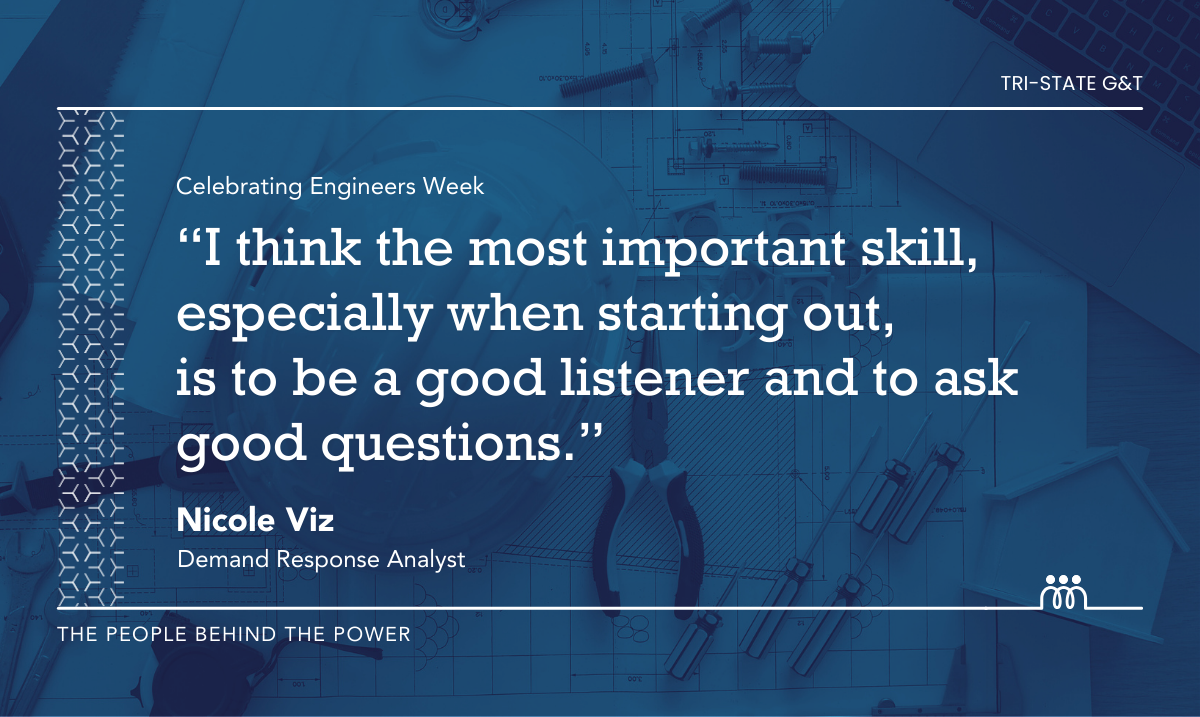
I think the most important skill, especially when starting out, is to be a good listener and to ask good questions. There is so much to learn from listening to the people around you, even in settings that you might not think are super relevant to your day-to-day work.
It’s also important to be patient and keep a flexible mindset when approaching challenges because engineers are problem-solvers, and if you don’t take the time to listen to and identify the problem, you can’t solve it.
Who do you work most closely with, and what do you enjoy about that collaboration?
I currently work most closely with my wonderful manager Jennifer Prokop, who is the head of the Demand Response team, and Daniel Thompson, who is the other analyst. They’re both incredibly intelligent and patient with me. They’ve been in the utility space for a while, so I’m really enjoying drawing from their expertise and being able to ask questions without feeling like a bother.
How do you stay curious and keep learning in a field that’s evolving so quickly?
Honestly, it feels impossible not to be. The energy landscape is constantly changing, especially battery technologies. I try to stay as informed as I can whether that's reading the news every morning or talking to experts who know a lot more than me. I’m lucky to have a network of people I can go to when I have questions and be able to trust their expertise.
What excites you most about where battery technology is headed in the next 5–10 years?
I’m excited to see more variation in the types of technologies being adopted. Right now, lithium batteries are the standard, but it seems like there’s a possibility for competition with things like sodium-ion or flow batteries. Different technologies have different advantages and benefits, so it’ll be exciting to see if/how they can drive factors like cost and safety across the industry.
How does your role support our members and their communities?
I’ve heard my manager Jen say, “The cheapest megawatt is the one you already have.” In other words, the most cost‑effective energy resource isn’t building or buying new generation — it’s strategically coordinating energy demand at critical times to save members' money and keep the lights on.
That’s exactly what a successful Demand Response program helps us do. By lowering peak demand, Tri‑State can avoid or delay investing in new capacity, which ultimately helps keep energy more affordable for everyone.
When we enroll our members (and their members) into these programs, they can earn incentives for simple, low‑impact actions that temporarily reduce their energy use. Whether it’s turning a thermostat down by one or two degrees on hot days, shifting a process to a different time, or calling on battery storage when it’s available, these small adjustments add up. And because they’re minimally disruptive to day‑to‑day operations, participants get real financial benefits for actions that are easy to take.
What’s one thing people might be surprised to learn about the team or culture at Tri-State?
I am continuously surprised at how varied everyone’s background and experience before their current roles at Tri-State. I naively assumed that everyone working at an electric utility might be some sort of engineer, but there’s quite a range in both technical and non-technical backgrounds and I see how that contributes to a great, welcoming culture and successful team dynamics.
If you could go back and talk to your younger self, what would you tell her about working as an engineer?
I would tell her to be more outgoing and less nervous, because people in this industry are incredibly welcoming and helpful. I would also encourage her to keep working hard, because the mission I contribute to now in my role is extremely rewarding and fulfilling.
--
From relationship managers to cybersecurity engineers to substation technicians, the people needed to power our cooperative are as unique as the territories our members serve. If you are interested in applying your skills to improve the lives and livelihoods of our members, check out open positions here.
Blog Posts
6 Energy-Saving Tips to Get Your Home Ready for Summer

Co-op-Powered Broadband Keeps People Connected When it Counts
Tri-State’s wholesale rates are stable, and forecasted to remain so to 2050

What is the Benefit of Being a Member of an Electric Co-op?