
Local Vision, Cooperative Strength
When Gunnison County Electric Association (GCEA) members began asking for more local renewable energy options, CEO Mike McBride faced a familiar challenge: How do you balance community priorities while maintaining the reliable power your members depend on every day?
For McBride, the answer wasn't choosing between local flexibility and reliability; it was finding a way to achieve both. That is exactly what Tri-State Generation and Transmission Association's Board Policy 115 was designed to solve.
Created to Meet Different Community Needs
The solution reflected a reality Tri-State recognized years ago: no two member cooperatives are exactly alike. Communities across Colorado, Nebraska, New Mexico, and Wyoming have different priorities, whether that means developing renewable resources, supporting economic growth, or strengthening energy resilience.
Through Board Policy 115, Tri-State created a framework that allows members to pursue those local goals while continuing to benefit from the reliability, affordability, and strength of the cooperative system. Today, projects such as a solar farm outside Crested Butte and hydro generation in mountain communities are examples of that approach in action.
Initially, the 2002 board policy stated co-ops could self-supply up to 5% of their energy requirements. In 2025, that flexibility expanded to 20% of their energy and capacity requirements through member-owned or member-controlled resources.
For Tri-State Senior Manager of Power Supply Sonia Grage, the policy reflects a longstanding principle. "Each member cooperative serves a unique community with distinct priorities, growth patterns, and energy goals," Grage said.
For co-ops seeking greater participation in their energy future, Tri-State created this solution to fit that need. Grage continued that the cooperative model was built on shared ownership and shared interests, and with BP 115, members have opportunities to create solutions pursuing locally developed resources where communities or members are seeking greater participation in their energy future.
From Policy to Projects
The impact of BP 115 can be seen throughout the Tri-State membership.
Today, 20 member systems operate 59 projects under the policy. The first, Coal Creek Hydro in Colorado, entered service in 2009. Since then, members have developed a diverse portfolio that includes 49 solar projects, nine hydro projects, and one wind project, with more in the pipeline.
Each project looks a little different because each co-op's goals are different. What connects them all is a common framework that allows local innovation while preserving the benefits of cooperative membership.
The Vision Comes to Life
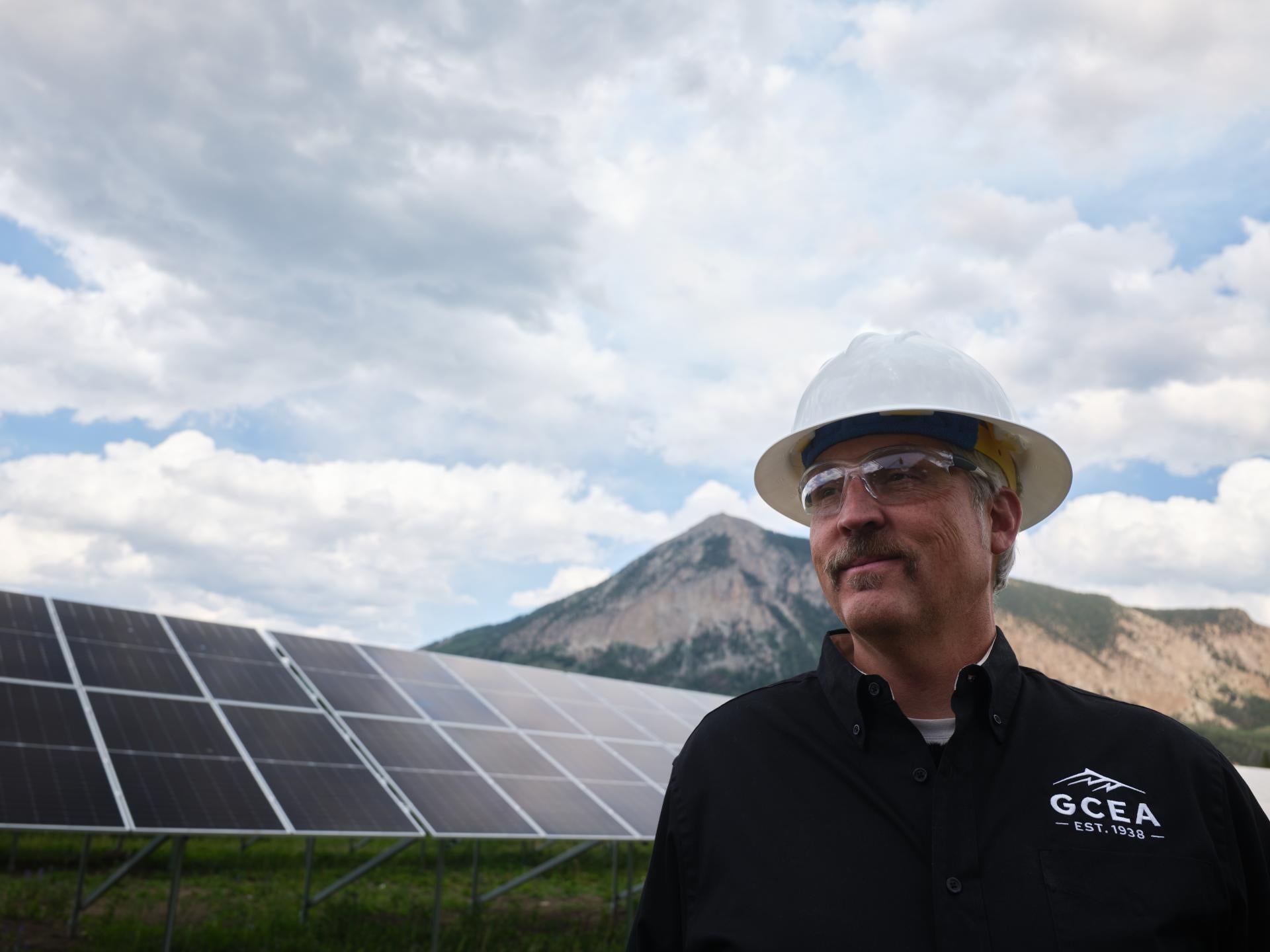
When GCEA stakeholders and leaders began exploring opportunities for additional renewable energy generation in the Crested Butte area, they were looking for a solution that reflected their unique priorities.
The result was the Oh Be Joyful Solar Farm, a project developed under BP 115 that demonstrates flexibility in action. The project joins a growing list of member-developed resources throughout the Tri-State system and illustrates the pathway BP 115 creates for communities that want to invest in new resources without leaving behind the reliability and support of the cooperative network.
Matt Feier, GCEA's strategy, execution, technology and member experience manager, remembers the effort to bring those projects to life. He recalls, what started as a desire "to get some local renewable energies on our grid" became a long-term effort requiring collaboration among the cooperative, Tri-State, developers, and the community itself.
What GCEA and the Town of Crested Butte discovered was that successful projects are ultimately people focused. When members clearly communicate priorities and cooperatives have the tools and flexibility to respond, projects can move from concept to reality.
More Than Local Generation
While projects like Oh Be Joyful are visible examples of BP 115 at work, the value extends beyond any single facility. For member cooperatives, participation in BP 115 means gaining flexibility without giving up the advantages of Tri-State membership.
McBride points to those benefits when describing GCEA's relationship with Tri-State.
"Whenever there's something, Tri-State is there," he said, recalling major outages and system challenges where Tri-State resources helped support those in need. "It's a symbiotic relationship," McBride said. That combination of local control and cooperative strength is exactly what BP 115 was built to support.
A Model Built for the Future
As member expectations continue to evolve, electric cooperatives are being asked to do more than simply deliver power. People increasingly want opportunities to participate in energy decisions, pursue local projects, strengthen resilience, and advance goals that matter to their membership.
BP 115 helps make that possible.
The policy creates room for innovation while preserving the reliability, affordability, and collaboration that defines the Tri-State system. It recognizes that different regions may take different paths while ensuring they remain connected to the benefits of cooperative membership.
For some members, that path may involve solar. For others, hydro generation, energy storage, or future technologies. What matters is that they have the flexibility to choose.
As McBride puts it, "The cooperative model is adapting."
Across the Tri-State membership, the growing number of BP 115 projects demonstrates exactly what that adaptation looks like: local priorities, member-driven innovation, and the enduring strength of co-ops working together to build the energy future that works for them.
--
About Tri-State
Tri-State is a power supply cooperative, operating on a not-for-profit basis, serving electric distribution cooperatives and public power district member-owners in four states. Together with our members, we deliver reliable, affordable and responsible power to nearly a million electricity consumers across roughly 200,000 square miles of the West. Visit www.tristate.coop.
Blog Posts

Protecting Your Home Year-Round from Wildfires
Summer Backpacking: Solar Power, Energy Efficiency, and the Best States to Visit

Beat the Chill: Effective Insulation Strategies for Winter Comfort
Energy Efficient Heating Options for Rural Communities in the West
Boost Your Business with EV Charging
The Benefits of Having Your Own EV Charger at Home
Geothermal Heat Pumps: Harnessing Earth's Energy for Your Business
Mastering Energy Efficiency with These Home Upgrades